
Hello,
Today’s blog post is a little different, because I am not going to talk about new features I have added to the game, but rather about my doubts and hesitations.
During April, I spent most of my time fixing technical bugs, especially battles between White factions (for example, when the Ukrainian anarchists encounter Russian generals). This has brought me up against the limits of GDevelop, the tool I use, but I do not intend to switch tools.
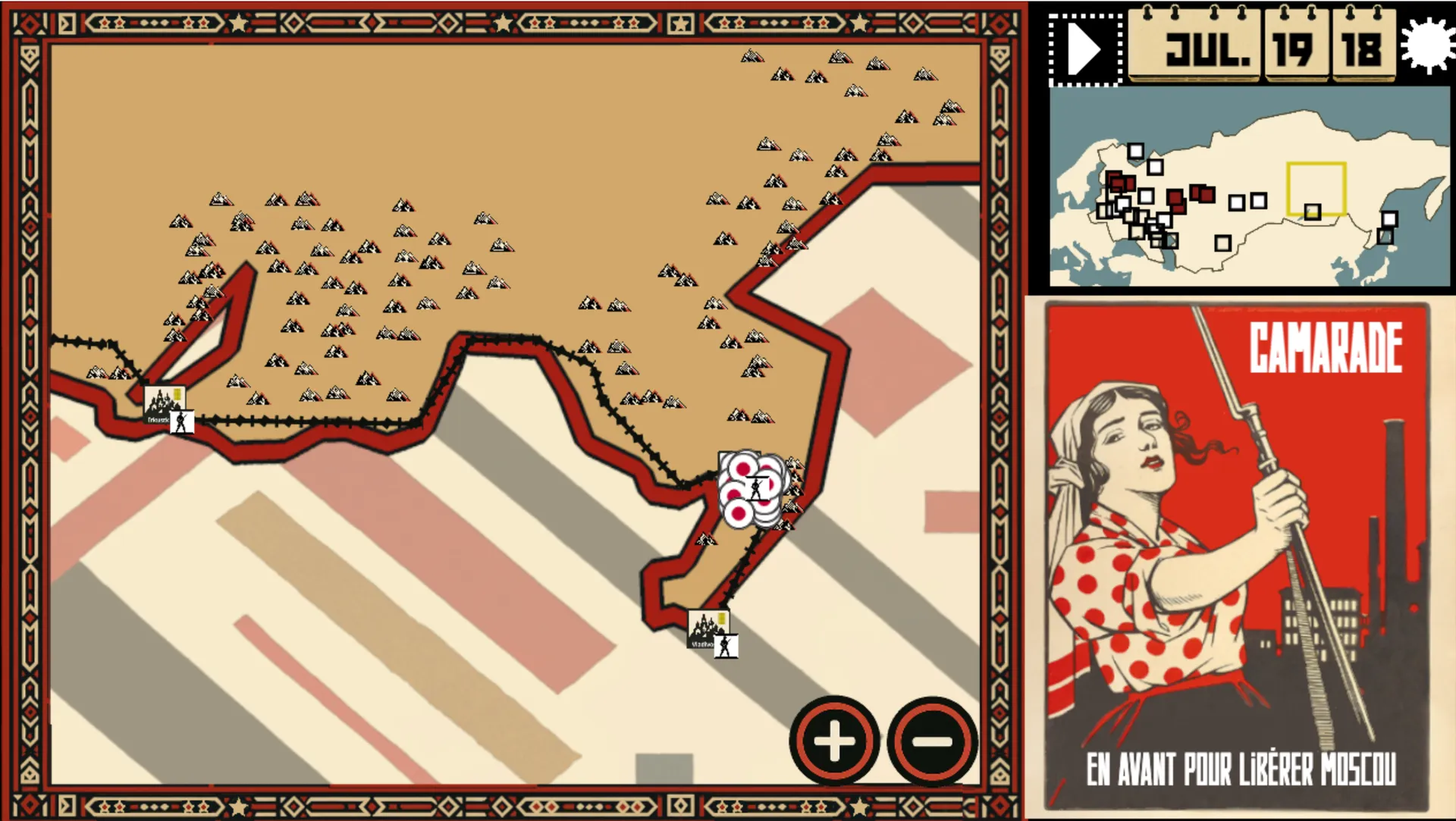
My situation is the following: generally speaking, I now have a perfectly respectable mobile strategy game. You can fight enemies, capture cities, produce new troops according to the available resources, and the enemy has decent artificial intelligence. All of this comes with an art direction inspired by the Soviet avant-garde, using simple shapes, red triangles and white circles reminiscent of the Soviet avant-garde style, such as El Lissitzky’s posters.
I have also added a historical framework in which enemies appear on the real dates of battles during the Russian Civil War (Japanese troops appearing in March 1918, Denikin’s forces appearing in June 1918, and so on). So it is already possible to replay history from the Bolshevik side in a relatively faithful way.
But that is not enough.
For one thing, the game is currently a simple game with only one possible ending and a single path. In short, there is nothing particularly remarkable about it apart from its design.
But more importantly, the true heart of the project, the part that interests me most, is the political question. At the moment, I have hit a wall.
My original idea was relatively ambitious: to integrate 43 major historical debates faced by Soviet leaders between 1917 and 1922 (granting independence to Finland, implementing War Communism, changing the calendar, etc.). Each time, the player could approve each choice or reject it, and in this way explore alternatives. The objective was simple: to observe how different political decisions might have changed the immediate strategic situation… but also the future of the Soviet Union. What it might have become.
On paper, the idea seemed excellent to me.
In practice, it creates a huge gameplay problem.
Forty-three debates are extremely heavy for a mobile player. Events end up appearing one after another without a clear logic from the player’s point of view. Choices appear mainly according to the historical context of the moment, sometimes almost “at random”, rather than because the player actively seeks them out. The result is a system that becomes difficult to read, tiring and, above all, not very enjoyable to play.
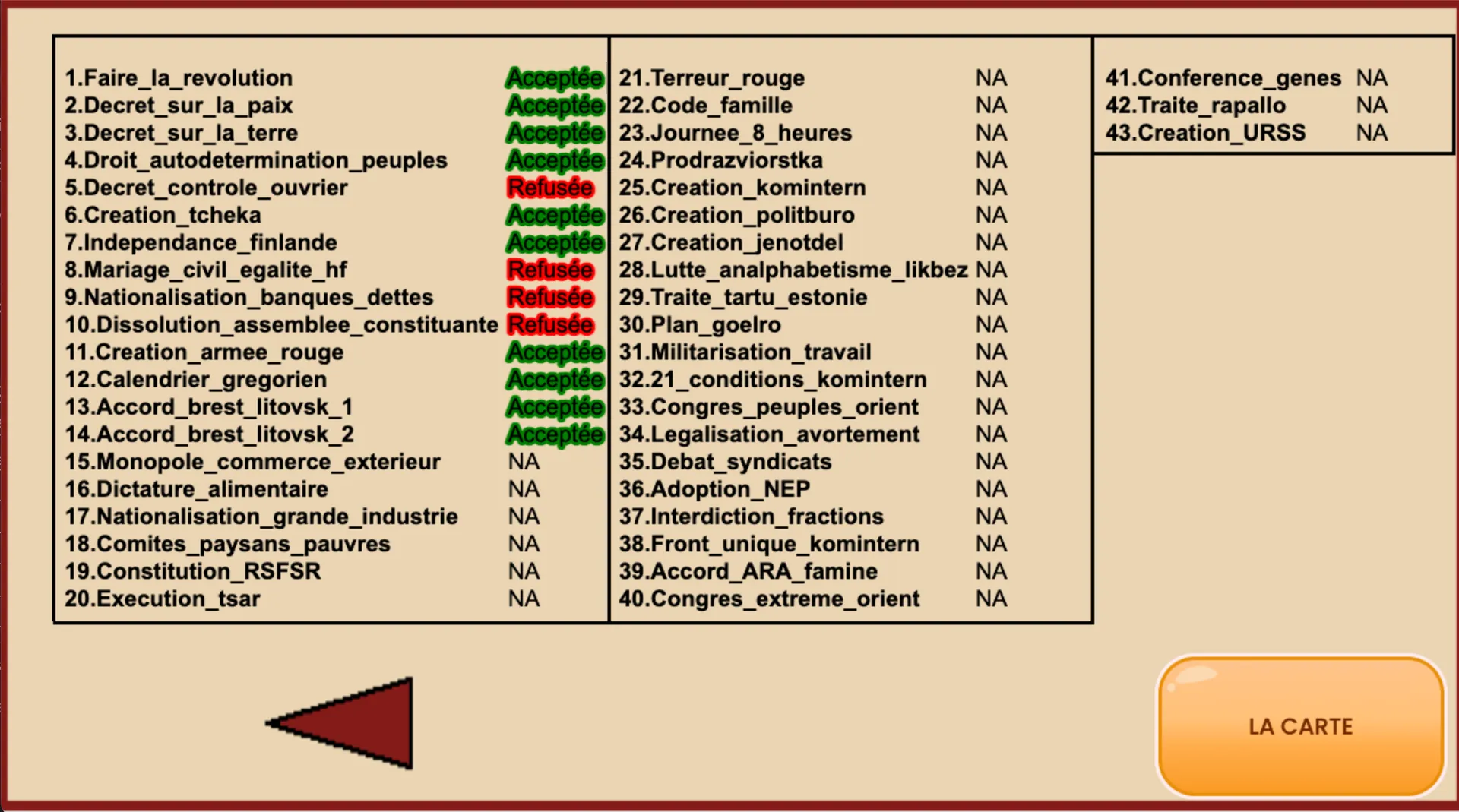
Menu summarising the choices made by the player during the game
And that is when I realised there was an important contradiction.
Of course, the debates need to appear in their precise historical context. But we cannot follow reality completely if doing so destroys the enjoyment of the game. A historically impeccable game that is painful to play is still a bad game.
Then I also had another thought.
While searching through the archives, I discovered the All-Russian Congress on Adult Education of May 1919. At that time, while battles were following one another, the Bolsheviks found the time to organise a congress on education and culture with the obvious aim of strengthening popular support for their struggle. And, of course, this issue was not one of my original 43 questions.
This clearly illustrates the difficulty of the project: the further I go in my historical research, the more new and important dynamics I discover that ought to be integrated into the game.
So I probably need to completely rethink the way political choices work in Russia 1917. Perhaps by using themes that group together the main debates. I do not know yet.
In short, I am trying to work out how to integrate the complexity of all this politics without making it too complex for the player. And it is genuinely difficult.
That is where I am at.
See you soon.