
Hello everyone,
Here is a short update on the work carried out during May 2026 on Russia 1917.
Development is progressing well, and I am particularly motivated at the moment. This month, I was able to resolve several important questions, especially about how to connect the player’s military, political and economic choices.
Strategic, political and economic choices
One of the game’s major challenges is to make the player feel that every decision carries weight.
In Russia 1917, the player leads the Bolshevik camp in the middle of an extremely unstable situation: civil war, foreign interventions, economic collapse, famines, national tensions, ideological debates… So it is not simply a matter of moving units around a map. You also have to govern a country in crisis.
The political debate system
I worked a great deal this month on the question of political debates.
The idea is simple: at certain moments, the player has to decide major political questions. For example:
- should Finland be granted independence?
- should a literacy campaign be launched?
- should an armistice be signed with Germany?
- should grain requisitions be tightened?
- should more authoritarian measures be taken against opponents?
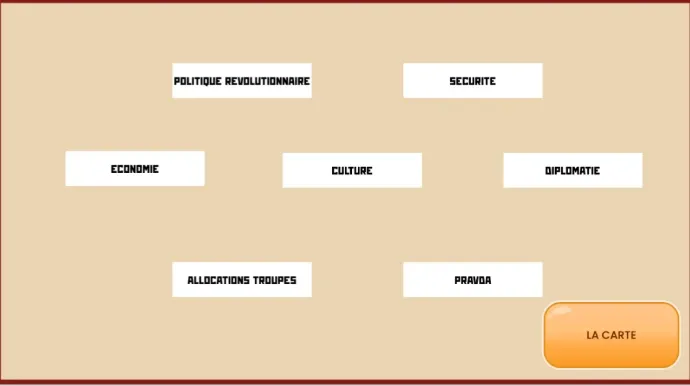
I want the player to be able to choose between several political orientations. For example, some decisions may make the White armies more aggressive. Others may influence production capacity or the level of popular support.
But I also want to avoid a classic problem in games: if every positive decision is free, the player will simply activate everything from the start.
So every choice needs to have a cost.
That cost can take several forms.
The player can settle only one decision per month. They will therefore have to choose their priorities at that moment. Do they focus on Finnish independence or on the allocation of resources? The player may decide to strengthen the army, but then risk neglecting the construction of the new regime. Conversely, they may invest in social or administrative policies, but that reduces the resources available for the war.
If the player chooses no political measure during the month, the game may either activate nothing or trigger certain events according to internal variables. The goal is for the country to keep living even when the player hesitates or focuses only on the front.
Then, once a policy is activated, resources have to be assigned to it. Launching a major literacy campaign, organising requisitions or strengthening a local administration requires people, officers, equipment and time. Those resources are then no longer available for the front. The allocation of each policy can be changed at any time, but each change has consequences.
In other words, the player does not merely choose an abstract political idea. They must also decide whether they are prepared to devote part of their means to it.
This makes it possible to create real dilemmas.
Three types of decisions during the game, leading to a final assessment
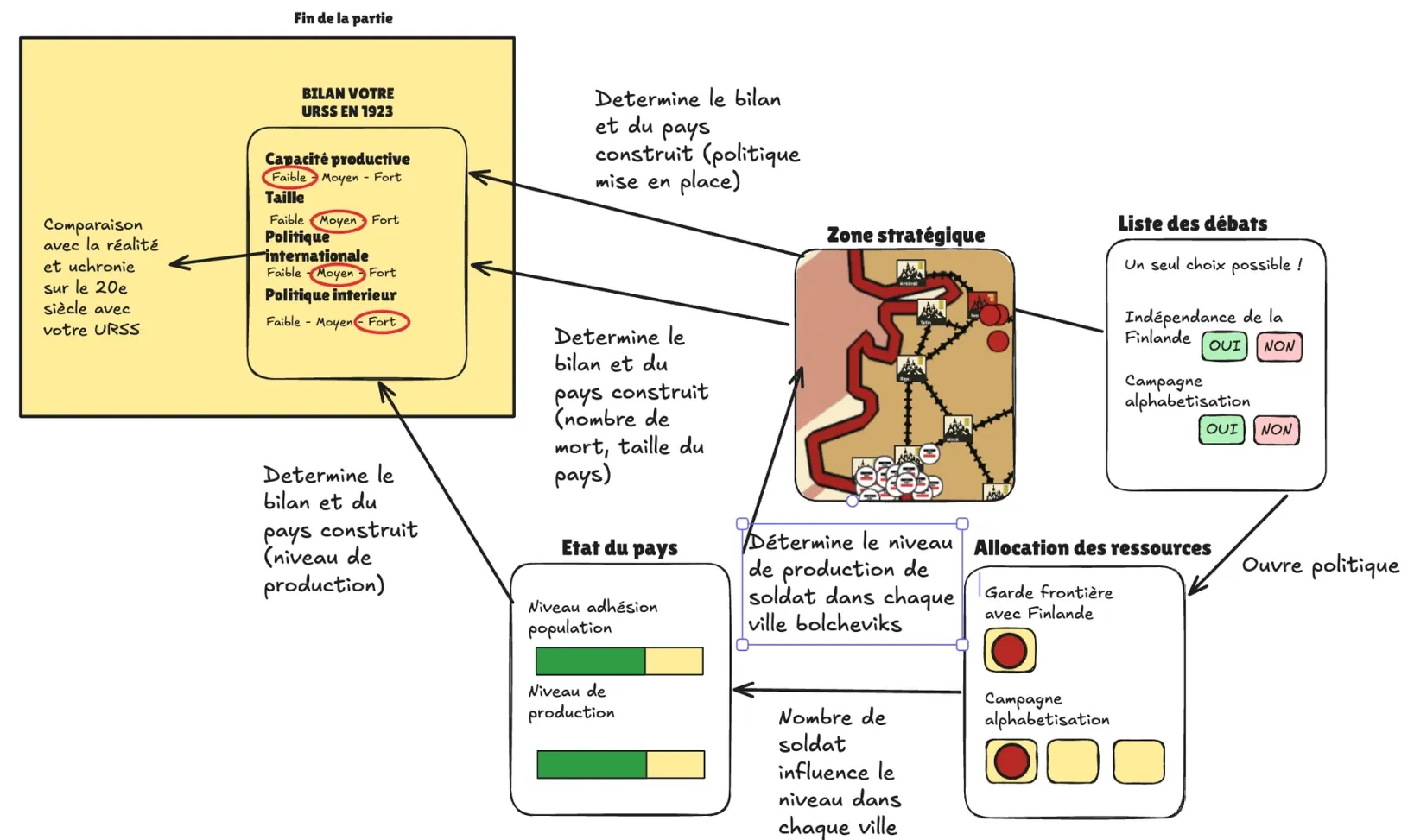
The diagram above summarises quite well the logic I want to implement.
During a game, the player will regularly have to make three types of decisions.
First, there are strategic choices: attack a city, defend a region, produce a unit, decide which enemy to confront first.
Then there are political choices: adopt a more conciliatory or more authoritarian line, accept or reject certain national demands, invest in education, propaganda or administration.
Finally, there are economic choices: where should the regime’s limited resources go? Into the army? Domestic policies? Production? Border control?
These decisions directly influence the situation of the Bolshevik camp during the game. But they are also stored in the game’s memory.
At the end, the player therefore receives more than just a military score. The game also produces a political, economic and social assessment of the state they have built.
Did they create a stable country? A vast but ruined country? A regime that was militarily victorious but politically isolated? A Soviet Russia reduced geographically, but more coherent? These are the kinds of outcomes I want to make possible. I will also add an alternate-history scenario explaining how your USSR would have influenced the twentieth century and the world.
The final goal is for a game lasting about an hour to lead to very different scenarios depending on the player’s priorities.
Testing the consequences of each decision with statistics
For now, I am mainly working on the concrete effects of each decision.
I need to determine how each choice changes production, available resources, the level of popular support, military capacity or the size of the country under control.
This also requires a series of statistical calculations. The idea is to simulate many simplified situations to check that the game does not produce absurd results.
For example, one policy should not always be too profitable, while another should not be systematically useless. I also have to check that the resources required remain consistent with the scale of the game.
I jokingly call this the game’s economy: the moment when I put political ideas into a spreadsheet to see whether they hold together.
Communicating decisions through Pravda to increase immersion
I also worked on how to present the decisions made by the player.
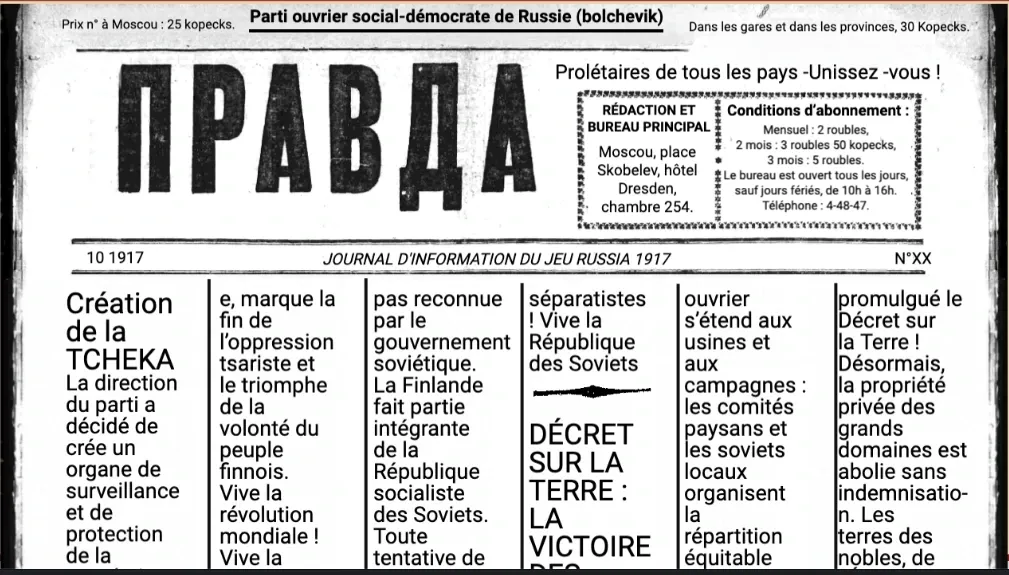
You can of course zoom in and move around the newspaper’s front page.
Rather than displaying everything as tables or technical windows, I wanted to give political announcements a more immersive form. The player’s major decisions will therefore be presented as a front page of Pravda, the Bolsheviks’ official newspaper, whose name means “truth” in Russian.
I drew inspiration from the layout of the period — you can see prices in roubles and the real address used at the time — while adapting it for reading on a smartphone.
The result works very well. It is readable, immersive, and really gives the impression that the player’s decisions are becoming historical events.
Eventually, I would even like to adapt the layout of Pravda according to the year, because the newspaper changed graphically between 1917 and 1922. But that is a small detail I am keeping for later.
Bug fixes and improvements to enemy AI
This month, I also reworked the enemies’ artificial intelligence, especially that of the White armies and foreign forces.
Each AI now has two main variables.
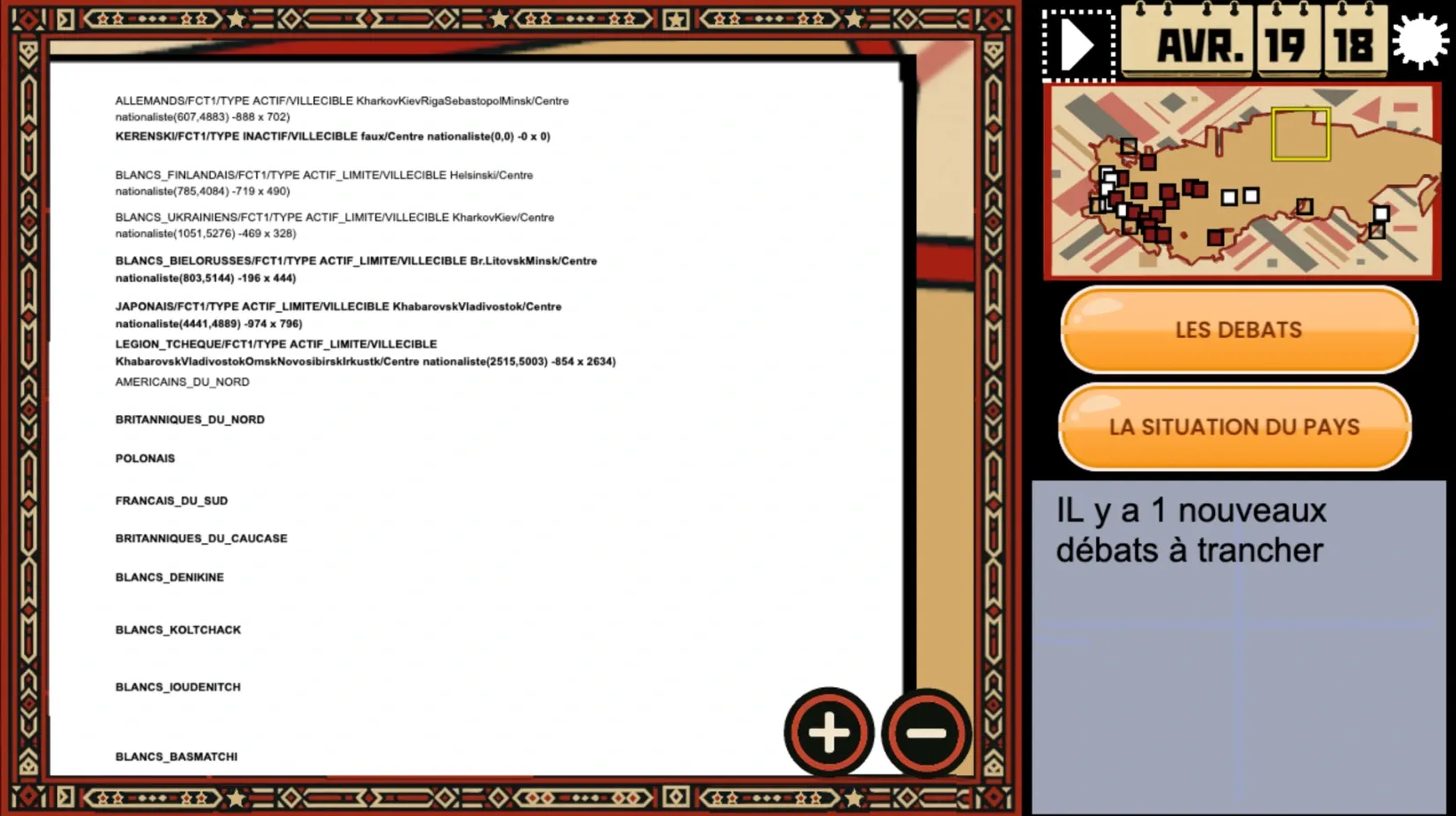
The first is its aggression level: the enemy can be inactive, active_limited to one region, or active_expansionist.
The second is its area of advance: some enemies can intervene across the entire map, while others remain restricted to certain regions.
This system lets me represent historical behaviour more accurately while still leaving room for alternative scenarios.
For example, the Germans can remain relatively neutral between October 1917 and January 1918. But depending on the player’s decisions, they can then become inactive or, on the contrary, launch an offensive in western Russia, as they did historically after the failure of the Brest-Litovsk negotiations.
In the same way, I can control each faction’s territorial ambitions. Will the Japanese remain in the Far East? Or will they try to advance much farther?
To monitor all this in real time during my tests, I created a table directly on the game map. It allows me to quickly see the behaviour of each camp and identify problems.
Conclusion
That is all for May 2026.
Development is progressing well. The systems are beginning to fit together more effectively: war, politics, the economy and the final assessment of the country are no longer separate elements, but different sides of the same problem.
That is exactly what I want to do with Russia 1917: make a game where winning the war is not necessarily enough, because you also have to decide what kind of country you are building in the middle of the chaos.
Work continues, and I am very motivated for what comes next.