
Hello everyone,
Here is a new update on the development of Russia 1917 and on the main subjects I focused on during June 2026.
A rewarding meeting
I had the opportunity to meet Landry, a YouTuber who specialises in video game creation and production.
He was able to test Russia 1917 and give me very interesting feedback on the project. This meeting gave me valuable advice, as well as an outside perspective on the game mechanics and on the experience offered to players.

YouTuber Landry
Rethinking the gameplay of the strategic map
This month, I mainly worked on the game’s central dynamic: the strategic map, where the player moves units and conducts military operations.
On mobile, this mechanic still creates a lot of friction. For example, the player may fail to select or move the desired unit on the first attempt. The zoom level can also change unexpectedly, making some actions imprecise or frustrating.
To try to solve this problem, I experimented with a system inspired by the mobile game Rebel Inc.
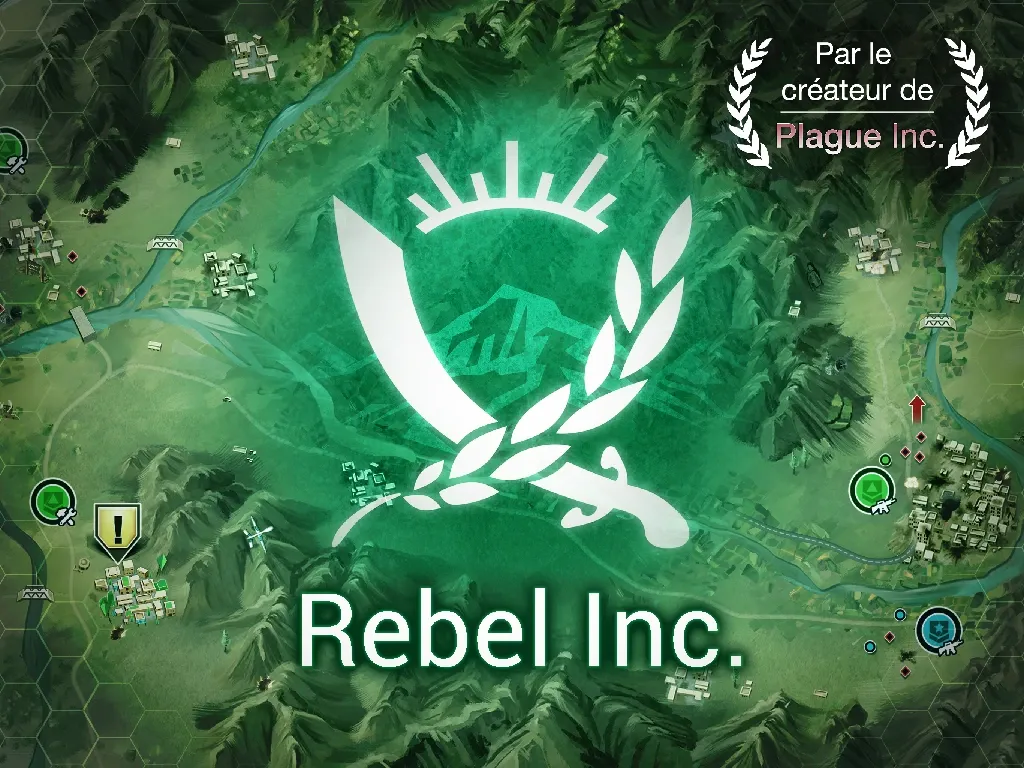
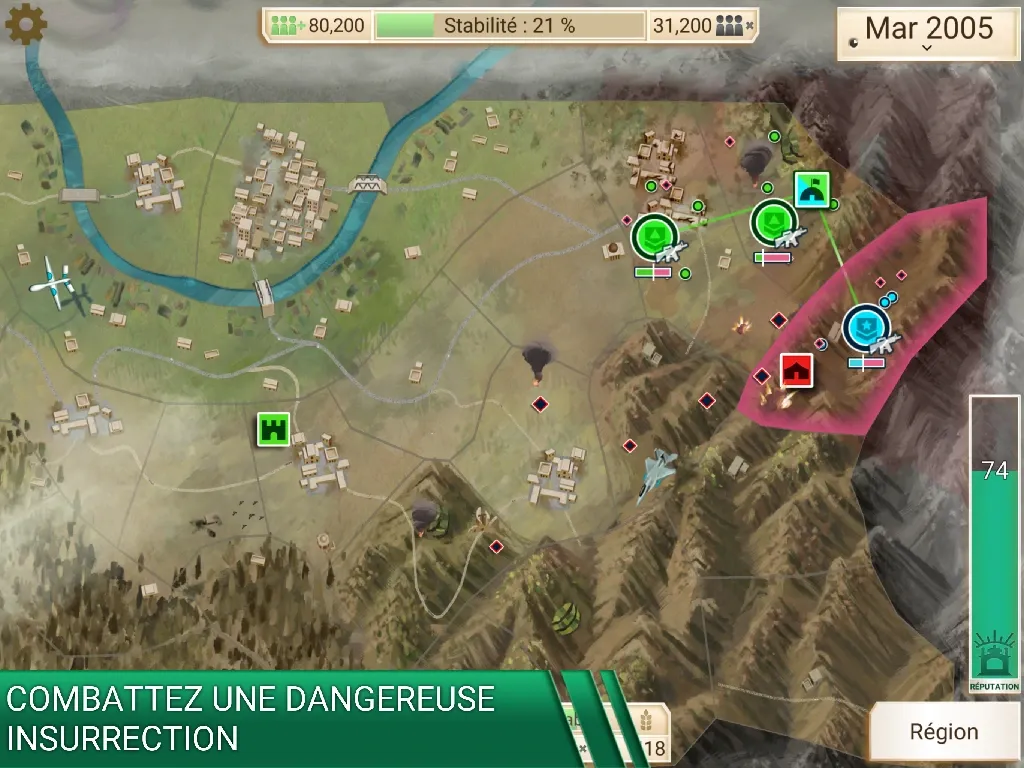
Screenshots from Rebel Inc. Click the image to access it.
In this game, which tells the story of a NATO-style occupation army intervening in a country inspired by Afghanistan, units do not move freely around the map. They move from one zone to another. When one of the player’s units and an enemy unit are in the same zone, a battle begins.
It is also a very good game for understanding certain dynamics of imperialism and military occupation. It is available for free on mobile.
In Rebel Inc., the map generally contains around thirty zones. There is no need to zoom, and all zones are roughly the same size.
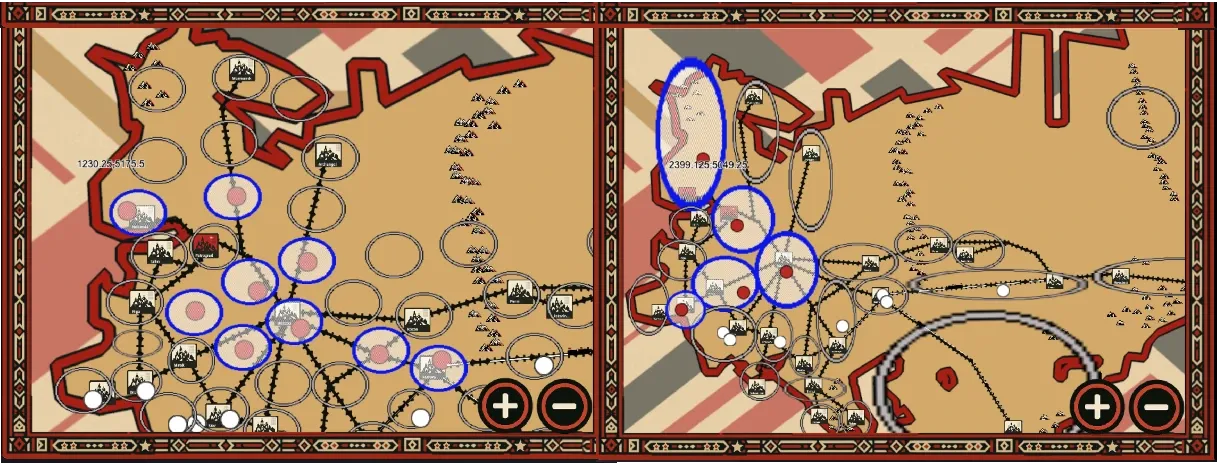
So I tested this method in Russia 1917, first with a map divided into 28 zones, then with a version containing 83 zones.
The problem of geographical scale
This approach quickly confronted me with several difficulties.
To remain historically coherent, I need to distinguish certain territories. For example, it would be difficult to combine Finland, the Baltic states and Poland into a single zone, because these regions had very different political and military situations.
The problem is that this produces zones of extremely unequal sizes.
On the 28-zone map, for example, the Turkmenistan region is about 24 times larger than the zone grouping the Baltic states.
The Russian Civil War took place across an immense territory made up both of vast, sparsely populated regions and much smaller territories that were politically or strategically essential. It is therefore difficult to create a division that is readable, balanced and historically relevant at the same time.
A 28-zone map
With 28 zones, the game retains a genuine strategic dimension and remains relatively easy to understand.
However, this simplification greatly limits the player’s possibilities. Only one unit can generally occupy each zone. Rail transport loses much of its usefulness, and it becomes impossible to outflank an enemy army or advance behind its lines.
The strategy therefore becomes clearer, but also much less rich.
An 83-zone map
With 83 zones, there are more tactical possibilities, but the experience quickly becomes repetitive.
The player spends a lot of time moving units from one zone to another and then waiting for battles to be resolved. The map also becomes less readable, especially on a phone screen.
This solution offers more precision, but ultimately does not solve the main usability problems.
So I decided to return to my original idea: a free-movement map, where each unit can move to a precise location.
My goal now is to preserve this freedom while reducing the friction involved in selecting units, moving them and zooming.
The main game design challenge: the debate menu
I now come to one of the most important topics in the project: the political debate menu.
As a reminder, the main purpose of this mechanic is to encourage the player to temporarily interrupt military activities in order to take part in political debates that will directly influence the strategic game, as well as the final assessment.
However, I do not want to artificially force the player to go there through restrictive timers, points that must be spent or arbitrary penalties.
The idea is that the player decides for themselves:
- whether they want to participate in a debate;
- which debate they consider the highest priority;
- whether they accept or reject the proposed policy;
- and how many resources they are prepared to devote to implementing it.
The player should feel that these debates matter without feeling that the game is constantly forcing them to leave the strategic map.
A new organisation for the political menu
To improve this part of the game, I completely redesigned the debate menu.
Previously, the player had to choose between five buttons and then consult the different available debates separately.
Now, the debates appear directly in a list organised by theme. Only debates that are currently available are displayed.
Each debate is accompanied by icons showing the types of consequences it may cause: territorial changes, military decisions, economic effects, political developments or ideological influence.
Debates that have already been completed also appear at the bottom of the list, with a stamp showing whether the proposal was approved or rejected.
The goal is to let the player quickly understand which decisions are pending, what consequences they may have and which choices have already been made.
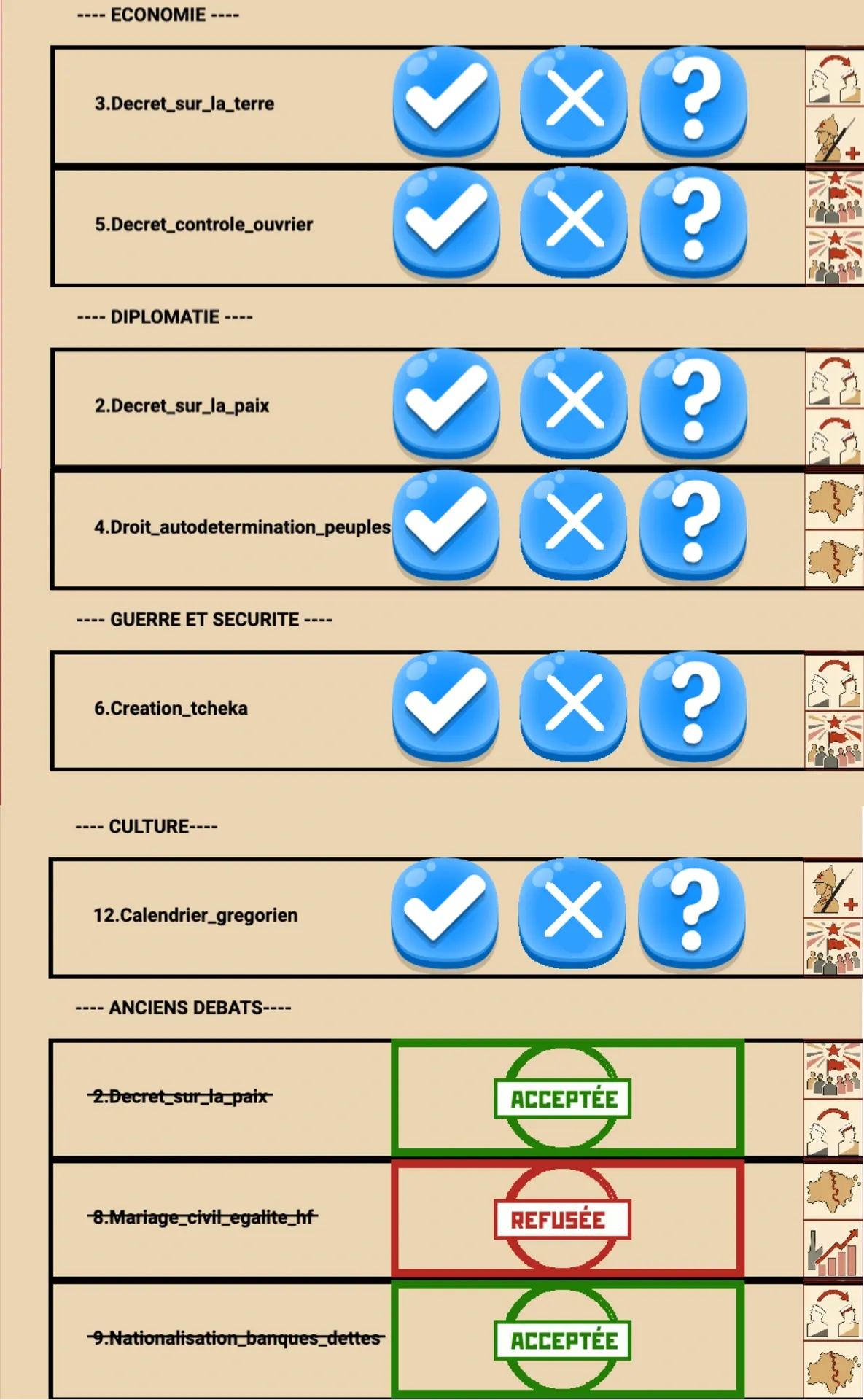
The new debate menu
Better connecting strategy and political debates
I still need to work on the connection between the strategic map and the debate menu.
For now, I think I am moving towards a progression in several stages.
During the first playthrough, debates would be resolved automatically by artificial intelligence. The player would receive notifications about the decisions made and could choose to participate in certain debates, but without any obligation.
After completing the game for the first time, they could start the campaign again and choose between several levels of political involvement.
In a first mode, they would simply give the artificial intelligence a general orientation on how to resolve the debates.
In a more advanced mode, they could impose their opinion on every debate. In that case, every political decision would have to be settled by the player.
This progression would make it possible to discover the different dimensions of the game gradually, without immediately overloading new players.
A more immersive political tunnel
When a player decides to participate in a debate, they enter a real political tunnel made up of several successive screens.
Once this path has begun, they cannot immediately return to the strategic map. They must first go through each stage of the process in order to consult the available information, make their decision, assign the necessary resources and discover the expected consequences of their choice.
The player begins by consulting Pravda, then the State of the Country menu, which brings together various reports on Russia’s political, social, economic and military situation. The goal is to lead the player to make an informed decision before settling the debate.
Once the decision has been made, they access the Economy menu, where they choose the resources devoted to implementing their policy.
They then return to Pravda to discover the expected consequences of their decision. Only after going through all these stages can they leave the tunnel and return to the strategic map.
Pravda reproduces the layout of the newspaper of the period. Texts produced by the game, describing the development of the playthrough and the consequences of political decisions, are inserted among genuine historical articles from Pravda.
The player may therefore find, next to an article about their own decisions, a text celebrating the anniversary of the Paris Commune or reporting on a strike that took place outside Russia. These events exist independently of the player’s actions and appear in the newspaper regardless of how they play.
This alternation between information generated by the playthrough and genuine articles from the period should strengthen the impression that the player is moving through a living historical world that does not revolve solely around them.
Pravda and the State of the Country menu nevertheless remain directly accessible from the strategic map when no debate is in progress. The player can therefore follow how the situation is evolving and understand decisions made by the artificial intelligence even if they choose not to intervene personally.
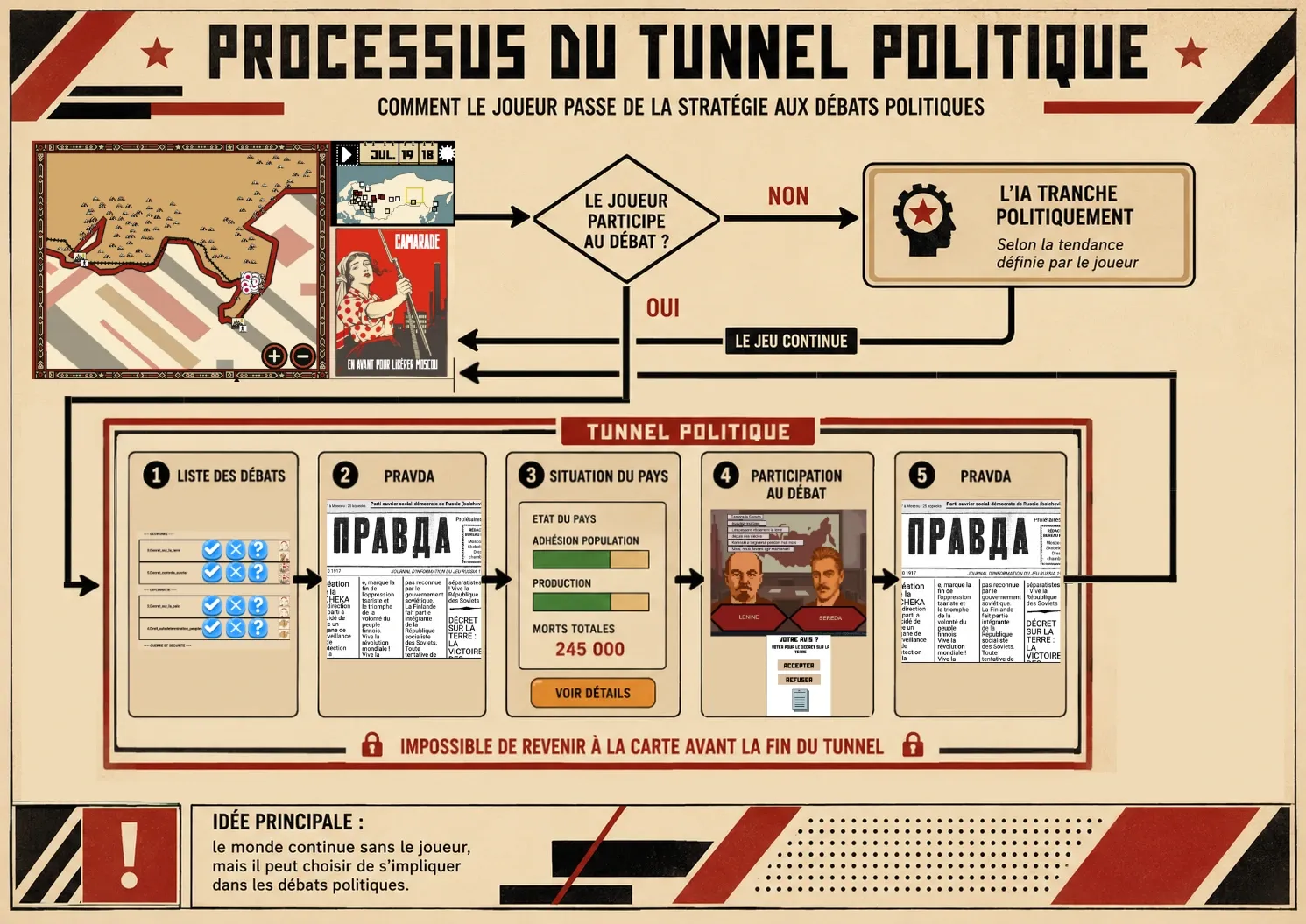
The debate process shown as a diagram
A world that continues without the player
Through this system, I want to convey several important ideas.
The first is to place as much information as possible in the Party newspapers and in reports on the state of the country. The player must search for useful information among texts inspired by the period, which should reinforce historical immersion.
The second is to show that the player is only one cog in a much larger political process.
Issues of Pravda continue to be published even if the player does not read them. Reports continue to be written, and political decisions are taken even if the player chooses not to become involved.
Finally, this system should allow the difficulty to increase naturally.
The player can complete the campaign for the first time without actively participating in debates. In a new playthrough, they can intervene occasionally. They can then choose to control every decision and precisely manage the resources required to implement their policies.
The game therefore gradually moves from a mainly strategic experience to a much more complete political, military and economic simulation.
What comes next in development
That is where the project currently stands.
The main objective in the coming weeks will be to continue improving the usability of the strategic map, while also strengthening the connection between military operations, political debates, Pravda, reports on the country and economic management.
Thank you very much for reading and for your support.
Don’t forget to subscribe to the Marxist Games newsletter so you don’t miss the next project updates.