Here is a new development update for Russia 1917 for December 2025.
This month was largely devoted to a central and delicate issue: game balance, especially since the complete overhaul of the White forces’ AI that began in November.
⚙️ White forces AI: the last piece of the puzzle
In November, I explained that I had completely rewritten the AI for the White forces.
One essential function still had to be implemented: the ability for certain White camps to create new troops.
That is now done.
All White camps can produce units, with the exception of foreign forces — the French, British, Americans, Germans, Japanese and the Czech Legion — which historically were not intended to create new troops made up of Russians.
⚠️ A major imbalance… and a paradox
Adding this feature has, however, created a massive imbalance in the game.
In its current state, winning as the Bolsheviks has become almost impossible.
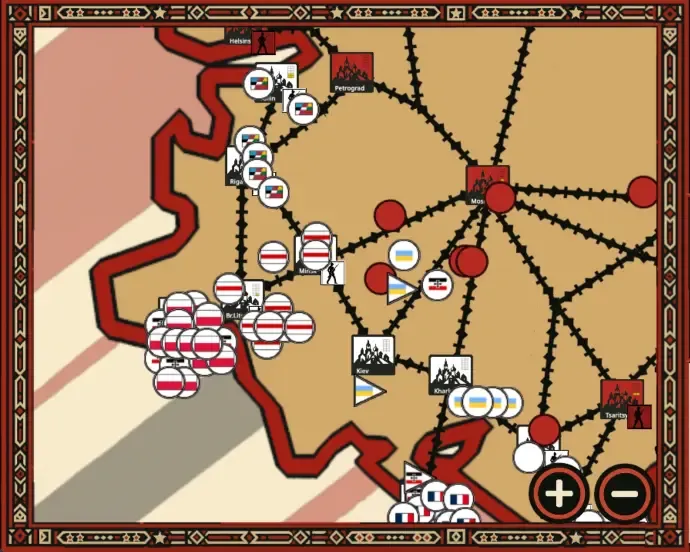
In some games, as in the example above, the White forces not only become overwhelming in number, but cities also lose almost all their ability to produce Bolshevik units.
And that is the paradox:
- In the previous version, the Bolsheviks were the only side able to produce units. Long-term victory was therefore relatively easy, with a total potential of 280 units that could be created, compared with 270 units appearing on the White side.
- Now the White forces can occupy a city for a long time, consume all of its resources by producing additional troops, and those resources are permanently lost to the Bolsheviks because production capacity does not regenerate.
📊 A few figures to understand the problem
If we make a simple calculation:
- The Bolsheviks automatically receive 13 new units.
- The different White camps automatically receive 207 units.
These figures correspond to historical foreign interventions — 70,000 Japanese troops, 30,000 men in the Czech Legion, and so on — assuming that one unit represents around 1,000 men.
There is then a theoretical “cake” of 280 units — 10 per city — to be shared.
It quickly becomes clear that maintaining balance is extremely difficult for the Bolsheviks, because the Whites can rapidly reach 300 to 350 units while the Bolsheviks necessarily have fewer.
Historically, however, the Red Army numbered more than one million men by the end of the Civil War. For obvious technical reasons, it is impossible to have 1,000 units moving simultaneously in the game. The forces therefore need to be rebalanced relative to one another.
🛠️ Attempts at rebalancing
Several limits have been introduced to deal with this situation.
🔒 Limiting the number of White troops
Each White camp now has a maximum number of simultaneous units.
For example, Finnish forces are limited to 20 units, preventing a single faction from completely draining a city’s resources.
🏙️ Weaknesses in city defence
The White AI still does not defend its cities perfectly.
This creates an opportunity for the Bolshevik player: temporarily occupy an abandoned city in an attempt to recover resources and produce new troops.
⚔️ Internal conflicts between White forces
Another important balancing mechanism has been added: conflicts between White camps.
Historically, not all enemies of the Bolsheviks formed a united bloc:
- Germans and British fought one another,
- the Makhnovshchina fought Ukrainian nationalists,
- the Kronstadt anarchists would never have cooperated with Denikin’s armies,
- and there were many other cases.
It was therefore necessary to introduce alliances, cooperation and internal conflicts.
🧩 Typology of the camps
The camps are now organised into broad categories:
- CENTRAL POWERS → Germans
- ENTENTE → North Americans, British (North and Caucasus), southern French forces, Japanese, Czech Legion
- REGIONALIST WHITES → Belarusians, Finns, Ukrainians, Poles, Balts
- NATIONALIST WHITES → Denikin, Kolchak, Yudenich, Kerensky
- FAR LEFT → Peasant Greens, Makhnovshchina, Kronstadt anarchists
- BOLSHEVIKS
Here is a table showing the conflicts between the different groups.
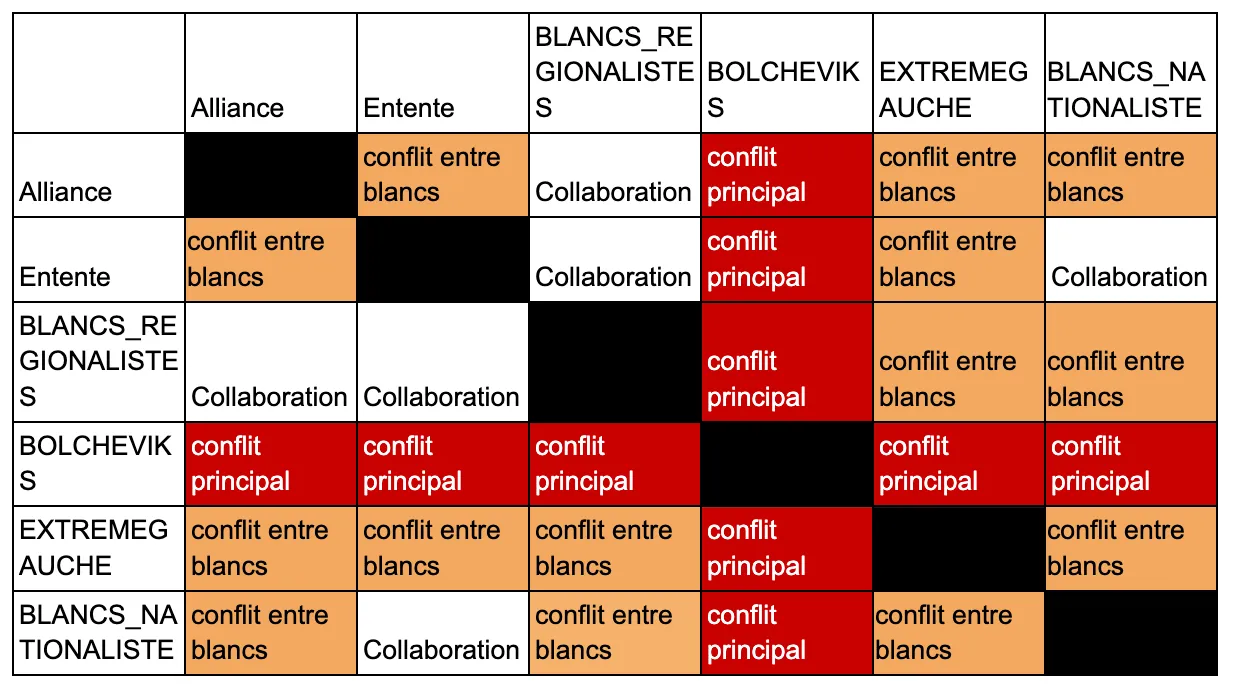
These internal clashes mechanically reduce the pressure on the Bolsheviks.
🌏 Points to watch
The balance remains fragile, particularly:
- in Siberia,
- and in the Far East, where the Japanese and the Czech Legion are very numerous and do not yet fight each other.
I am considering:
- increasing the number of Bolshevik troops available,
- especially in major cities such as Moscow and Petrograd, which have more resources available than secondary cities.
I also want to reward certain political decisions with the arrival of new troops. For example, implementing the decrees on land or peace could trigger the spontaneous creation of units in different cities.
🧠 Other progress in December
ℹ️ Tooltips and documentation
A new tooltip system has been added, providing detailed information on each White camp, sometimes accompanied by photographs of historical figures.
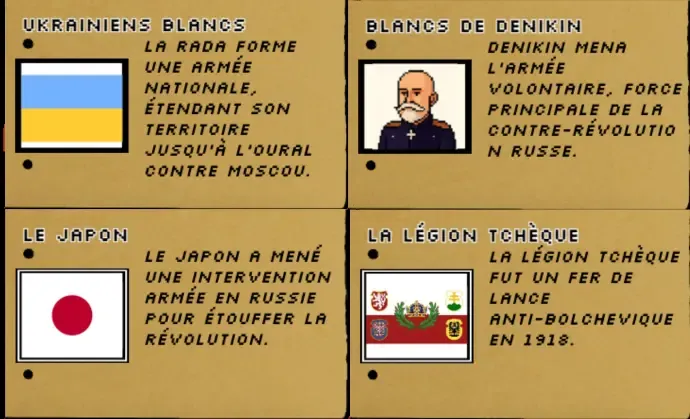
(The perforated cards 😉 are there to give them a period feel.)
The information comes in particular from:
- The History of the Civil War in the U.S.S.R. (Moscow, 1936),
- and Lenin’s collected works.
I have also tested pixel-art portraits of Denikin, Kolchak and others.
That does raise a question: we must avoid humanising or making appealing forces that were fundamentally reactionary, and in some cases proto-fascist.
🚆 Movement by rail
Finally, Bolshevik troops now correctly follow railway lines over long distances. A short video illustrates this improvement.
🔧 Next steps
- Fix several bugs, in particular:
- Denikin, Kolchak and Yudenich are still too static in combat.
- Prevent certain forces from leaving their area of operations — Japanese troops tried to march on Moscow during one game.
Before publication on the Play Store, two major areas of work remain.
🏁 The end of the game
The game ends in January 1922, with the creation of the USSR.
The aim is to compare the USSR created by the player:
- with historical reality,
- but also with other possible USSRs.
A USSR that captured Warsaw and connected with Berlin would obviously not be the same as a USSR reduced to Moscow and Petrograd.
The challenge is to make players want to play again and discover several possible outcomes.
🏛️ Political decisions
Each month, the player will take part in internal discussions within the Bolshevik Party and will have to take a position:
- Agree to the Treaty of Brest-Litovsk?
- Introduce War Communism?
- Create the Cheka, the political police?
The game will explain the consequences of each choice, placing the player in a context comparable to that faced by Bolshevik leaders and encouraging reflection on what might have been done differently, and at what cost.
Feel free to test the game here