
Hello,
Here is the current state of development of Russia 1917, covering the work carried out during January and February.
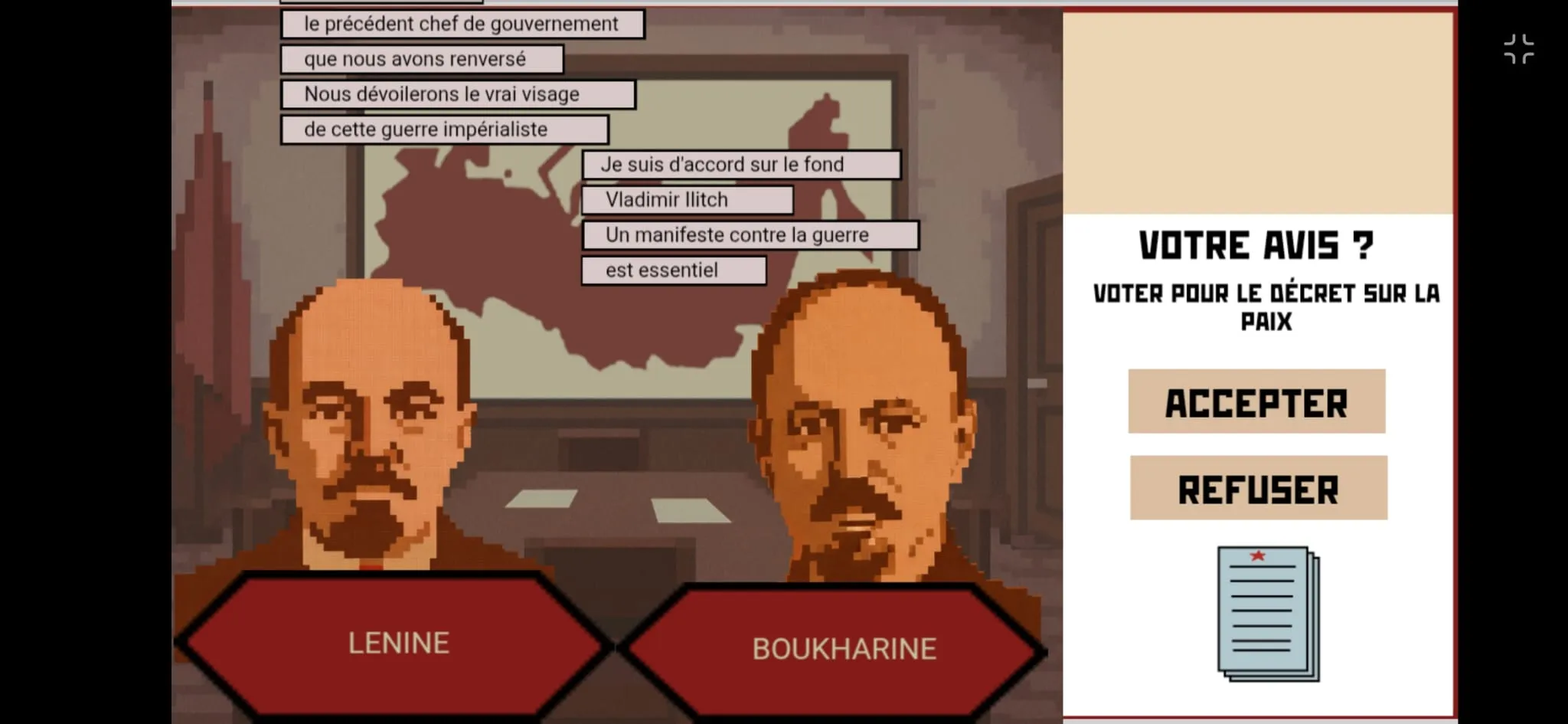
Now that the strategic map is working well, I wanted to start working on the dynamics of the scenarios. The idea is to let the player take part in the internal debates of the Bolshevik Party through a series of political decisions. The consequences of those choices then appear on the strategic map.
For example, if the player recognises the independence of Finland, as happened historically, Finnish troops will no longer attack the young USSR. If, on the other hand, the player decides not to create a Red Army and relies only on the Red Guard, it then becomes impossible to build a genuine army, and so on.
To construct these debates, I relied on three important documents:
- Ten Days That Shook the World by John Reed (1919), in French
- The History of the Civil War in the U.S.S.R. (1937), in English
- History of the Communist Party of the Soviet Union (Bolsheviks) (1938), in French
- as well as Lenin’s Collected Works for the period 1917–1922 (volumes 26 to 45, in Russian)
Using these sources, I created 43 debates taking place between November 1917 and December 1922.
Here is the list:
- Faire_la_revolution
- Decret_sur_la_terre
- Decret_sur_la_paix
- Droit_autodetermination_peuples
- Decret_controle_ouvrier
- Creation_tcheka
- Independance_finlande
- Mariage_civil_egalite_hf
- Nationalisation_banques_dettes
- Dissolution_assemblee_constituante
- Creation_armee_rouge
- Calendrier_gregorien
- Accord_brest_litovsk_1
- Accord_brest_litovsk_2
- Monopole_commerce_exterieur
- Dictature_alimentaire
- Nationalisation_grande_industrie
- Comites_paysans_pauvres
- Constitution_RSFSR
- Execution_tsar
- Terreur_rouge
- Code_famille
- Journee_8_heures
- Prodrazviorstka
- Creation_komintern
- Creation_politburo
- Creation_jenotdel
- Lutte_analphabetisme_likbez
- Traite_tartu_estonie
- Plan_goelro
- Militarisation_travail
- 21_conditions_komintern
- Congres_peuples_orient
- Legalisation_avortement
- Debat_syndicats
- Adoption_NEP
- Interdiction_fractions
- Front_unique_komintern
- Accord_ARA_famine
- Congres_extreme_orient
- Conference_genes
- Traite_rapallo
- Creation_URSS
At the moment, I have completed 5 of the 43 debates.
To stage these debates, I have two characters discuss the issue. For example, here is a video showing a discussion between Lenin and Zinoviev about whether to launch the revolution before the opening of the Congress of Soviets.
Problems of dynamic structure and pacing
Implementing these 43 scenarios revealed two major problems.
1. A genuinely dynamic structure
Each scenario has an effect on the game, and that effect is usually quite easy to implement. For example, introducing War Communism increases the number of troops available for creation. In itself, this is fairly simple because it only requires changing a value.
However, for the sake of consistency, each previous decision can make later debates irrelevant, or conversely create new ones. For example, if you grant independence to every people that asks for it, you will need fewer troops and some political measures such as War Communism automatically become less necessary. Likewise, choosing not to establish a political police could mean that certain uprisings such as Kronstadt never occur.
This means that some debates should appear only under certain conditions. We therefore move from a clearly marked path, where debates take place on known dates if historical decisions are followed, to a much more open path in which debates may never happen at all or may appear at different times depending on the situation on the ground.
This is work I still need to tackle, but I already had to take it into account while designing the game’s data structure.
2. The pacing problem
I would like the game to last at least around one hour. There are 62 months between November 1917 and December 1922, the date of the creation of the USSR and the end of the game, which means that each month can last only about 60 seconds.
The problem is that many debates occur right at the beginning of the game:
- 5 in November 1917
- 3 in December 1917
- 3 in January 1918
Since each debate lasts around 1 minute, from the player’s point of view this means:
- 1 minute on the strategic map in November 1917
- then 5 minutes to resolve the five debates of November 1917, which can potentially be skipped
- then 1 minute on the strategic map in December 1917
- then 3 minutes to resolve the debates of December 1917
- and so on.
In short, the pacing is completely broken.
I am trying to solve this by making the debates optional, using a simple notification rather than forcing the player to take a position immediately. But since the most important debates take place during the first few months, something is still lost. This is an issue I am still trying to solve.
Player experience
I also had the opportunity to have the game tested under real conditions by two people. Several issues emerged:
- A control problem: at first, selecting soldiers is not easy. For zooming, I need to implement a pinch gesture instead of keeping zoom buttons.
- A scenario / objective problem: the player does not receive enough information about what they are supposed to do.
- A readability problem: there is far too much information on the screen instead of distributing it more effectively across several interfaces.
Most importantly, the screen is occupied by propaganda posters and by an artwork that is constructed during the game — I discuss it in this article — but it permanently takes up almost 15% of the screen without adding much to the experience.
In short, I need to substantially rework the user experience and implement a good tutorial.